Research into Target Audience
I carried out this research in order to gain more knowledge of what my target audience would like to see so that I can make my opening sequence appeal to my target audience. When making my questionnaire I decided to ask 40 people to get a larger amount of results for my questionnaire so that I can have a wider range of opinions on what I should add or omit. With these results I can alter my plans for my opening sequence so that I will make an opening sequence that is both conventional and fits into what my audience want to see so it is more enjoyable for them.

What Gender Are You?
 This question was asked to determine the gender of our target audience we asked. The information told us there were slightly more men then women asked in the question. This tells us that when we come to make the thriller we should add more violence as this is more interesting to male viewers, who we have more of. Stereotypically men enjoy violence more when it comes to their thriller film whereas women are seen as enjoying more of a psychological thriller. As there are more men in questioned group they may wish to see a man as the main victim as it would make the plot more relatable to them. When making our own opening sequence we had already planned for the main victim to be a female as we believed it would be more conventional to the genre, these results show that the female victim is a more conventional character. This will be done so the characters can be more appealing to the target audience because this is what they want to see and will enjoy more to see.
What Age Are You?
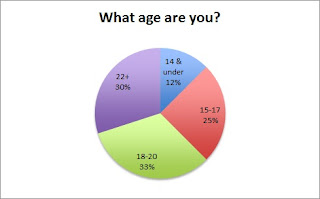 This question was asked to determine the age of our target audience we asked. The information we gathered told us that the largest group of ages were from 18-20 and the second largest group being 22+. This tells us that when we come to making our opening sequence that we can add more content that fits into the higher age certificates as we will be able to do more things that we can get away with like violence and swearing while still having an audience that will be able to view the film. When we come to making our opening sequence we could show more blood and a longer chase scene that the victim is in at the end of the opening sequence when the killer confronts her to show more violence and create more suspense in the audience as the fight would show more danger and lethal nature of the situation and so would become more appealing to the age of our target audience as it contains the content they want to see.
What's Your Favourite Type of Thriller Sub-Genre?
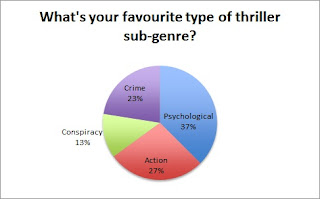 This question was asked to determine what sub-genre our target audience liked. The information we gathered told us that the favorite sub-genre our target audience liked was the psychological thriller with the second most liked genre was the action thriller. This tells us that when we come to making our opening sequence that we should focus more on elements of a psychological thriller by focusing on plot twists and playing with what the audience thinks is going to happen by having the narrative have unexpected twists and turns. In our piece we have decided to have a plot twist when the victim turns out to overpower the killer and kill him with little effort which will lead the audience to not understand who the dominant character is and what the real killer will do next as the chain of events has been disorientated. Using plot twists and altering the expected conventions of the genre to throw the audience off of what they expect to be going on will appeal to them as it will follow more of a psychological thriller narrative.
What Weapon Would You Like To See Used?
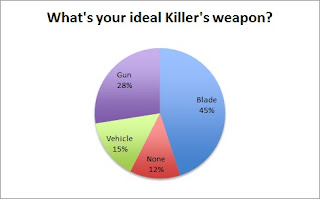 This question was asked to determine what weapon our target audience would like to see. The information that we gathered told us that the killer using a blade was the most chosen weapon while the second was a gun. This tells us that when we come to making our opening sequence that we should have the antagonist use a knife as a weapon in order to satisfy what our target audience. In our opening sequence we will have the killer approach the victim with a knife in his hand and threaten her with it but after a fight between them the victim uses the knife to kill the killer showing how the knife comes in to play as it will be used by the victim to save herself. The knife will be used to connote danger in the sequence and how the power balance is being shifted in the scene as the knife is changing hands between both characters. This will be used to create shock and tension in the audience as they will have to wait until the end of the fight to see who will come out on top. This will also satisfy our target audience as they want to see the antagonist using a knife to kill his victims and may want to see the killer perform his kills silently and get away with it if he is using a knife, a weapon that has silent connotations.
Which of These Settings Do You Find Most Conventional To Thrillers?
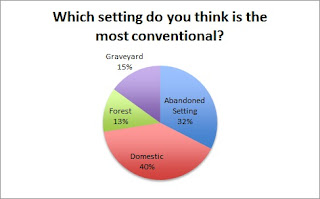 This question was asked to determine where the target audience would like the setting to be. The information that was gathered told us that the target audience would like the opening sequence to be in a domestic setting with the second highest option being an abandoned setting. This tells us that when we come to making our opening sequence we should set it in a domestic setting in order to fill what our target audience want. In our opening sequence we can set parts of it in the victims house with the killer shown in the background to show that the killer is smarter than her as he is able to follow her and find where she lives without being found. The use of a domestic setting will allow the audience to recognize that the killer is able to break into an area where the victim should be safe and be comfortable showing how he has power over her. This will create surprise in the audience as they will not be expecting the killer to be able to get to the victim in her house as it is perceived as being a place where someone is safe and they should not be threatened in their own home. This will also satisfy our target audience as the sequence may be set in part in the victim's home which will allow the audience to see the strength and wit of the killer as he can penetrate the victim's defenses.
What Is Your Favourite Thriller Film?
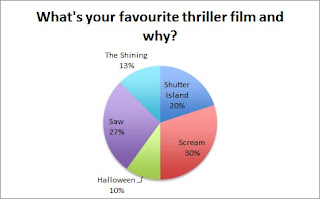 This question was asked to determine what the target audience's favourite thriller film is and how we can use this to influence our own opening sequence. The information we gathered told us that Scream was the audience's favourite thriller film with Saw being second faovurite. With the answer of Scream our target audience said that they liked the familiar settings and characters that were featured in the film and thought the film was relatable to them. When we are making our opening sequence we can employ this into our own piece and feature a setting that the audience can relate to through the use of the school or a home setting as well as making sure our characters are recognizable and relatable to the audience through their behavior and actions like having the victim being an everyday schoolgirl in a school that most of our audience can relate to. This will make the audience feel more familiar and related to the audience so they can feel more connected to the characters and empathize with them more as they can see themselves in the character's shoes in the hostile situations they find themselves in. This will be used to make sure the audience are satisfied in that it allows them to see some of their favourite film in our film and so make them see parallels in each other and enjoy our opening sequence.
Which Of The Following Creates More Tension?
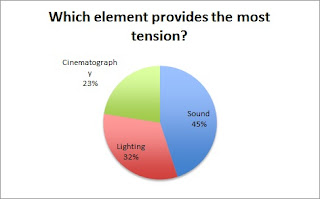 This question was asked to find out what the audience think created more tension for them while watching, with the options being light, camera and sound. The information that was gathered showed us that the audience felt that sound created the most tension for them with lighting being the second highest. This tells us that when we are making our opening sequence we should pay extra attention to what the audience can hear as they feel that that is what affects them the most. This can be done by adding loud non-diegetic eerie music when the killer is stalking the victim at the end of the sequence before he attacks her. This will create suspense in the audience as they want to know what the outcome of the situation will be and why the music has changed to something so extreme all of a sudden. This will satisfy the target audience as they want to hear sound that makes them feel tension and my including it in an already tense scene this will add more to the tension already shown.
Would You Rather Have The Antagonist's Identity Hidden Until The End or Revealed Straight Away?
 This question was asked to find out if the audience think that the killer's identity should remain hidden. The information gathered told us that the audience would like to see the killer's identity hidden for as long as possible. This tells us that when we come to make our own opening sequence we should strive to have the killer's identity hidden for as long as possible. We could add this by making sure that the killer's identity is not shown through the usage of costume to cover his face and stop the audience or victim from recognizing the killer. This will create suspense in the audience as they want to know who the killer is and why he has targeted the victim as they may have a history together but the audience's imagination is left to think of why the killer has started murdering people. This will satisfy the target audience as the killer's identity will be hidden which leaves his identity and motivations up to the audience so that they can engage more with the story as they try to figure out the narrative.
Do You Think The Main Victim Should Be Male or Female?
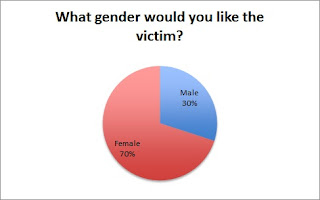 This question was asked to determine whether the audience wanted to see a female or male victim. The information gathered told us that the people we asked would like to see a female victim. This tells us that when we come to making our own opening sequence we should have our victim be a female character. We will do this by having our victim be a girl who is shown as being weak through low angled shots and introducing her as a schoolgirl to the audience. This will create sympathy for the victim as the audience do not know if she will be able to oppose the killer and survive through the events of the film as she is being portrayed as weaker than the killer so it should be hard for her to overpower the killer. This will satisfy the target audience as the victim being a female will mean she is less likely to win in a fight and so this will create more tension and suspense throughout the sequence. The female character is often stereotyped as being weaker than the male character and so the female will have to work hard to overcome the male if they get into a fight.
Should The Main Antagonist Be Male or Female?
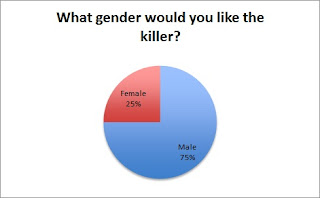 This question was asked to determine whether the audience would like to see a male or female antagonist. The information gathered told us that the audience would like to see a male antagonist in our opening sequence. This tells us that when we come to make our opening sequence we should make sure to show that the antagonist is a male who is killing people. We will show this by making sure the audience is aware that the killer is a male, this ill be shown in his stance and his face when he is unmasked at the end of the sequence. This will create suspense in the audience as when the killer and the victim finally confront one another the audience do not know if the victim will be able to get away or whether she will be killed by the killer. This will satisfy the target audience as they want to see an antagonist that is a male as it will connote that he can overpower the victims and that the victims will have to work harder to survive as the male is stereotyped as being stronger than the female characters.
Vox Pops
A Vox Pop is a recorded interview that shows a snapshot of the public opinion, the name comes from 'Vox Populi' which is latin for 'voice of the people', that I have recorded as part of how I gathered my research and how I can use these to alter my plans. I used Vox Pops in order to show evidence that I had carried out my questionnaire and how I asked the questions and gathered the information while also showing the different variances in the people I asked with a varied group of people and how their opinions differed. My Vox Pops also allowed the people I questioned to expand upon their answers and give a more detailed response.
In conclusion, the research I have collected has allowed me to see what my target audience want to see in our opening sequence with their input allowing us to alter what we have planned to make sure our target audience enjoy it more. like how we are going to use a knife for the antagonist when he is attacking the victim to show his power over the victim as that is what the target audience want to see as well as including a more domestic setting to make the target audience relate more to the narrative and get a sense of how powerful the killer is as he can penetrate where she is safe. Another idea used for the target audience was the use of a female victim that can connote that the character is weak which can create suspense for the character if they get into a fight with a male character. If I were to carry out the research again I would use a larger group of people to analyse in order to get a larger amount of results and get a more accurate idea of what the target audience want.
 This question was asked to determine the age of our target audience we asked. The information we gathered told us that the largest group of ages were from 18-20 and the second largest group being 22+. This tells us that when we come to making our opening sequence that we can add more content that fits into the higher age certificates as we will be able to do more things that we can get away with like violence and swearing while still having an audience that will be able to view the film. When we come to making our opening sequence we could show more blood and a longer chase scene that the victim is in at the end of the opening sequence when the killer confronts her to show more violence and create more suspense in the audience as the fight would show more danger and lethal nature of the situation and so would become more appealing to the age of our target audience as it contains the content they want to see.
What's Your Favourite Type of Thriller Sub-Genre?
 This question was asked to determine what sub-genre our target audience liked. The information we gathered told us that the favorite sub-genre our target audience liked was the psychological thriller with the second most liked genre was the action thriller. This tells us that when we come to making our opening sequence that we should focus more on elements of a psychological thriller by focusing on plot twists and playing with what the audience thinks is going to happen by having the narrative have unexpected twists and turns. In our piece we have decided to have a plot twist when the victim turns out to overpower the killer and kill him with little effort which will lead the audience to not understand who the dominant character is and what the real killer will do next as the chain of events has been disorientated. Using plot twists and altering the expected conventions of the genre to throw the audience off of what they expect to be going on will appeal to them as it will follow more of a psychological thriller narrative.
What Weapon Would You Like To See Used?
 This question was asked to determine what weapon our target audience would like to see. The information that we gathered told us that the killer using a blade was the most chosen weapon while the second was a gun. This tells us that when we come to making our opening sequence that we should have the antagonist use a knife as a weapon in order to satisfy what our target audience. In our opening sequence we will have the killer approach the victim with a knife in his hand and threaten her with it but after a fight between them the victim uses the knife to kill the killer showing how the knife comes in to play as it will be used by the victim to save herself. The knife will be used to connote danger in the sequence and how the power balance is being shifted in the scene as the knife is changing hands between both characters. This will be used to create shock and tension in the audience as they will have to wait until the end of the fight to see who will come out on top. This will also satisfy our target audience as they want to see the antagonist using a knife to kill his victims and may want to see the killer perform his kills silently and get away with it if he is using a knife, a weapon that has silent connotations.
Which of These Settings Do You Find Most Conventional To Thrillers?
 This question was asked to determine where the target audience would like the setting to be. The information that was gathered told us that the target audience would like the opening sequence to be in a domestic setting with the second highest option being an abandoned setting. This tells us that when we come to making our opening sequence we should set it in a domestic setting in order to fill what our target audience want. In our opening sequence we can set parts of it in the victims house with the killer shown in the background to show that the killer is smarter than her as he is able to follow her and find where she lives without being found. The use of a domestic setting will allow the audience to recognize that the killer is able to break into an area where the victim should be safe and be comfortable showing how he has power over her. This will create surprise in the audience as they will not be expecting the killer to be able to get to the victim in her house as it is perceived as being a place where someone is safe and they should not be threatened in their own home. This will also satisfy our target audience as the sequence may be set in part in the victim's home which will allow the audience to see the strength and wit of the killer as he can penetrate the victim's defenses.
What Is Your Favourite Thriller Film?
 This question was asked to determine what the target audience's favourite thriller film is and how we can use this to influence our own opening sequence. The information we gathered told us that Scream was the audience's favourite thriller film with Saw being second faovurite. With the answer of Scream our target audience said that they liked the familiar settings and characters that were featured in the film and thought the film was relatable to them. When we are making our opening sequence we can employ this into our own piece and feature a setting that the audience can relate to through the use of the school or a home setting as well as making sure our characters are recognizable and relatable to the audience through their behavior and actions like having the victim being an everyday schoolgirl in a school that most of our audience can relate to. This will make the audience feel more familiar and related to the audience so they can feel more connected to the characters and empathize with them more as they can see themselves in the character's shoes in the hostile situations they find themselves in. This will be used to make sure the audience are satisfied in that it allows them to see some of their favourite film in our film and so make them see parallels in each other and enjoy our opening sequence.
Which Of The Following Creates More Tension?
 This question was asked to find out what the audience think created more tension for them while watching, with the options being light, camera and sound. The information that was gathered showed us that the audience felt that sound created the most tension for them with lighting being the second highest. This tells us that when we are making our opening sequence we should pay extra attention to what the audience can hear as they feel that that is what affects them the most. This can be done by adding loud non-diegetic eerie music when the killer is stalking the victim at the end of the sequence before he attacks her. This will create suspense in the audience as they want to know what the outcome of the situation will be and why the music has changed to something so extreme all of a sudden. This will satisfy the target audience as they want to hear sound that makes them feel tension and my including it in an already tense scene this will add more to the tension already shown.
Would You Rather Have The Antagonist's Identity Hidden Until The End or Revealed Straight Away?
 This question was asked to find out if the audience think that the killer's identity should remain hidden. The information gathered told us that the audience would like to see the killer's identity hidden for as long as possible. This tells us that when we come to make our own opening sequence we should strive to have the killer's identity hidden for as long as possible. We could add this by making sure that the killer's identity is not shown through the usage of costume to cover his face and stop the audience or victim from recognizing the killer. This will create suspense in the audience as they want to know who the killer is and why he has targeted the victim as they may have a history together but the audience's imagination is left to think of why the killer has started murdering people. This will satisfy the target audience as the killer's identity will be hidden which leaves his identity and motivations up to the audience so that they can engage more with the story as they try to figure out the narrative.
Do You Think The Main Victim Should Be Male or Female?
 This question was asked to determine whether the audience wanted to see a female or male victim. The information gathered told us that the people we asked would like to see a female victim. This tells us that when we come to making our own opening sequence we should have our victim be a female character. We will do this by having our victim be a girl who is shown as being weak through low angled shots and introducing her as a schoolgirl to the audience. This will create sympathy for the victim as the audience do not know if she will be able to oppose the killer and survive through the events of the film as she is being portrayed as weaker than the killer so it should be hard for her to overpower the killer. This will satisfy the target audience as the victim being a female will mean she is less likely to win in a fight and so this will create more tension and suspense throughout the sequence. The female character is often stereotyped as being weaker than the male character and so the female will have to work hard to overcome the male if they get into a fight.
Should The Main Antagonist Be Male or Female?
 This question was asked to determine whether the audience would like to see a male or female antagonist. The information gathered told us that the audience would like to see a male antagonist in our opening sequence. This tells us that when we come to make our opening sequence we should make sure to show that the antagonist is a male who is killing people. We will show this by making sure the audience is aware that the killer is a male, this ill be shown in his stance and his face when he is unmasked at the end of the sequence. This will create suspense in the audience as when the killer and the victim finally confront one another the audience do not know if the victim will be able to get away or whether she will be killed by the killer. This will satisfy the target audience as they want to see an antagonist that is a male as it will connote that he can overpower the victims and that the victims will have to work harder to survive as the male is stereotyped as being stronger than the female characters.
Vox Pops
A Vox Pop is a recorded interview that shows a snapshot of the public opinion, the name comes from 'Vox Populi' which is latin for 'voice of the people', that I have recorded as part of how I gathered my research and how I can use these to alter my plans. I used Vox Pops in order to show evidence that I had carried out my questionnaire and how I asked the questions and gathered the information while also showing the different variances in the people I asked with a varied group of people and how their opinions differed. My Vox Pops also allowed the people I questioned to expand upon their answers and give a more detailed response.
In conclusion, the research I have collected has allowed me to see what my target audience want to see in our opening sequence with their input allowing us to alter what we have planned to make sure our target audience enjoy it more. like how we are going to use a knife for the antagonist when he is attacking the victim to show his power over the victim as that is what the target audience want to see as well as including a more domestic setting to make the target audience relate more to the narrative and get a sense of how powerful the killer is as he can penetrate where she is safe. Another idea used for the target audience was the use of a female victim that can connote that the character is weak which can create suspense for the character if they get into a fight with a male character. If I were to carry out the research again I would use a larger group of people to analyse in order to get a larger amount of results and get a more accurate idea of what the target audience want.


