Opening Scene Narration
In order to make our group storyboard as we all had to first come up with an individual storyboard. After we created our individual storyboards we all sat down together in class and began to write out our group storyboard that would incorporate as many aspects of our individual storyboards as possible. We lifted the best parts of each of our individual storyboards into the group storyboard in order to create a piece that was not only containing work from all of us to create a joint effort, but also to make sure only the best is used and to smooth out any inconsistencies.
In the first frame, the audience see an extreme close-up of a picture of the victim, so there will be no required actors in the shot and the setting will be the killer's planning room. The iconography will be the photo of the victim and the lighting will be low-key lighting. The audience will hear silence and as it is the first shot there will be no editing as there is nothing to edit from.
In the second frame, the audience will see a close-up of the planning board in the planning room where the killer seemingly plans his murders, there will be no actors in this shot and the location will still be in the planning room. The iconography will be more photos of the victim and her school, as well as older victims, and the lighting will be low-key lighting. The audience will hear he start of eerie music to connote something bad is happening and the editing will be linking of shots to the previous shot.
In the third frame, the audience will see a close-up of the planning board but it is becoming more distant now, there are still no actors and the setting is still in the planning room. The iconography is the same as before with some more photos and some notes pinned to the planning board and the lighting is low-key lighting. The audience hear the continuation of the eerie music heard previously. The editing is more linking of shots between the previous shot.
In the fourth frame, a mid-shot is used with the killer finally in view of the audience and the planning board becoming less central as the focus is shifted towards the killer, so the killer is now a required actor as he has finally appeared and the setting is still the planning room. The iconography is the planning board and the knife that the killer is holding while the lighting is low-key lighting. The audience will hear more of the eerie music as it continues on and the editing will be more linking of shots to show they are all connected.
In the fifth frame, an establishing shot will be used of the outside of the school to show the audience where the scene is located, so there will be no actors or iconography featured, and there will be a fade into this shot. There will be the off-screen sound of a bell ringing and natural high-key lighting will be used in the shot.
In the sixth frame, a tracking shot of the victim will be used outside of the school to show the victim is attending school and in a safe area, so the victim will be featured in the shot, but there will be no iconography, with there being a fade into this shot from the previous shot, there will be the off-screen sound of a school bell heard ringing and natural high-key lighting will be used.
In the seventh frame, the audience will see an over the shoulder shot of the victim inside the school swiping her id card to show that she is located in the school, iconography included will be an id swipe card that the victim uses and the only actor in the scene will be the victim. The audience will hear the on-screen sound of a beep and the shot will use high-key lighting, while there will also be straight cut transition from the last scene.
In the eighth frame, a low angle shot of the victim walking down the hallway will be seen with creep following her close behind, so the scene will have the victim and the creep in it with no iconography featured, and there will be a straight cut from the last shot. The audience will hear silence except for the on-screen footsteps and there will be high-key lighting in the shot.
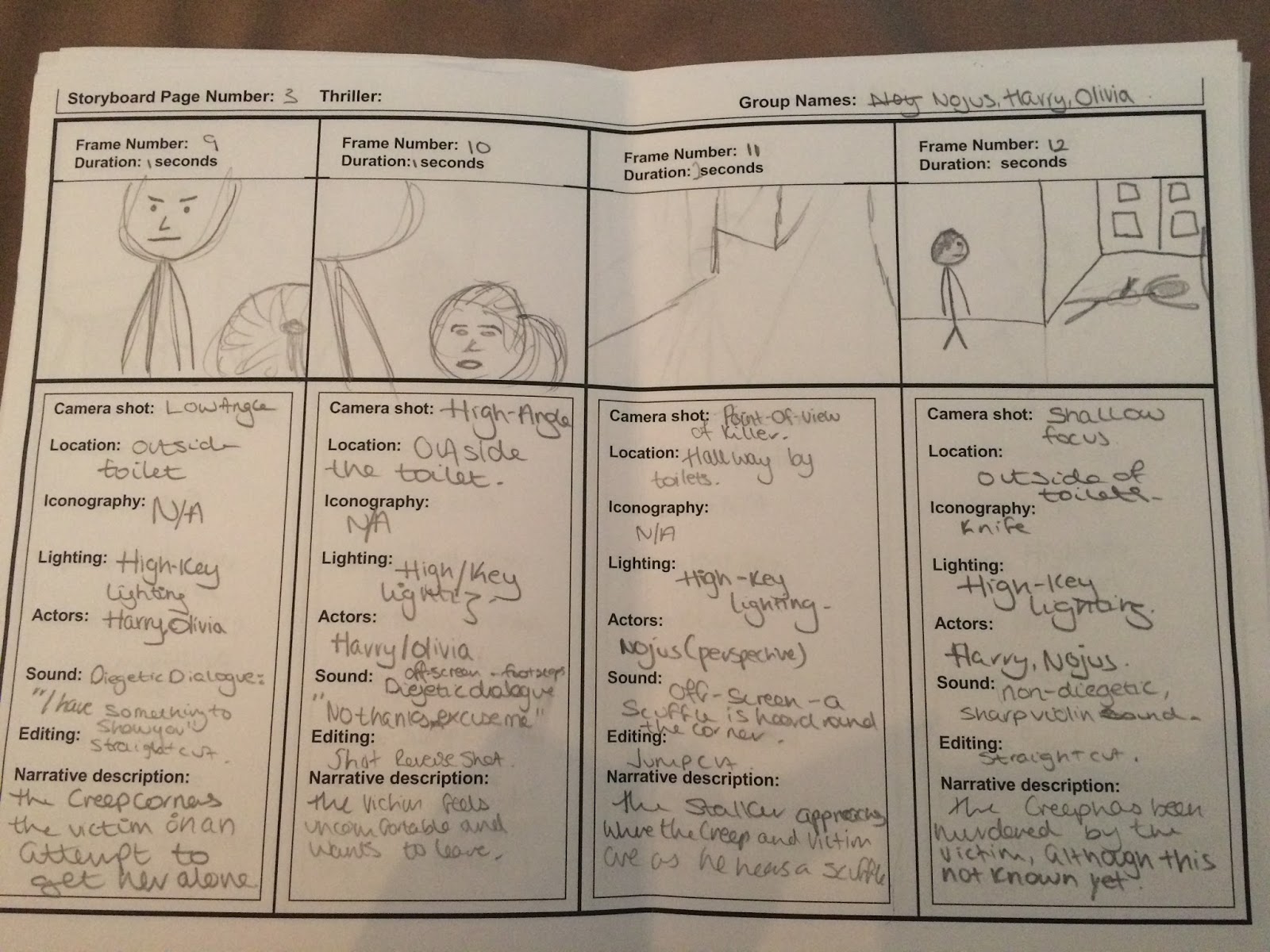
In the ninth frame, the audience see a low angle shot of the creep as he talks to the victim in the hallway, so the scene will have the victim and the creep in it, and there will be no iconography used. There will be a straight cut from the last shot to this one and there will be high-key lighting used in the scene. The audience will hear diegetic dialogue of "I have something to show you".
In the tenth frame the audience will see a high-angle shot of the victim's response to the creep, still taking place in the hallway and still containing the victim and the creep. There will be no use of iconography in this scene and the lighting will be high-key lighting. The audience will hear diegetic dialogue of "No thank you, excuse me", and as this is a conversation the editing used will be a shot reverse shot.
In the eleventh frame the audience will see a point of view from the killer's perspective as he comes down the same hallway the victim and creep are in, so the actor would be the killer. There will be no use of iconography and the light will be high-key lighting. the audience will be able to hear off-screen sound of a small scuffle taking place between the victim and the creep. The editing from the last shot to this shot will be a jump cut.
In the twelfth frame, the audience will see a shallow focus of the killer about to turn the corner where the audience can see the creep's dead body with a knife sticking out, so the actors used will be the creep and the killer and the location will be thee hallway again to keep up with continuity. The iconography in this scene will be the knife and the lighting will be high-key lighting. The audience will hear a non-diegetic sound of something like a sharp violin sound to emphasize the stabbing. The editing of this shot from the last will be a straight cut.
In the thirteenth frame, the audience see a low angle shot of the killer looking surprised at the death of the creep when he finds his body, so the actors needed for this shot would be the killer and the creep and the setting would be the same hallway as before to keep up with continuity. The iconography used would be the knife in the creep and the lighting would be top lighting. The audience will hear the non-diegetic sound of eerie music beignning to play in the background that is quite low. The editing from the last shot to this shot would be a jump cut.
In the fourteenth frame, the audience sees an over the shoulder shot of the victim walking away from the scene and the killer is looking on after her, so the victim and the killer would be required for this scene and the setting would be the same hallway as before but it would have moved away from where the body is. There would be no iconography used for this scene and the lighting would be high-key lighting. The audience will hear a continuation of the non-diegetic eerie music that would now be progressively more louder as the scene goes on. The editing from the last shot to this shot would be a jump cut.
In the fifteenth frame, the audience sees a close-up of the victim looking back at the killer as she walks off to hint that she did it, the actors required would be just the victim and the setting would be at the bottom of the stairwell further down the hallway. The would be no iconography used or this scene and the lighting would be top lighting. The audience will hear the eerie non-diegetic music continue to play but begin to get more fast-paced to signify the fast-paced events that are to come. The editing used in this scene would be a reaction shot of the victim's face.
In the sixteenth frame, the audience sees a cantered angle of a long shot of the killer beginning to chase after the victim after telling her to stop, so the actors required would be the killer and the setting would be the stair well as he has begun chasing her. There is no iconography used in this scene and the lighting would be high-key lighting. The audience will hear the non-diegetic eerie music get lower while the diegetic dialogue of the killer yelling "Hey!", The editing used in this scene will be another reaction shot of the killer to what the victim is doing.
In the seventeenth frame, the audience will see that the killer has followed the killer down the hallway and out of the building to find that the victim has vanished through a deep focus, the actors required for this scene would just be the killer and the setting would be outside the school for this. There is no iconography in this scene and the lighting will be natural high-key lighting. The audience will hear silence when this shot is shown and the editing used will be a jump cut from the last shot.
In the eighteenth frame, a zoom in will be used as the killer is knocked unconscious by the victim although this is not known by the audience, so the actors required would be the killer and the victim and the setting would still be the outside of the school. The iconography in this scene will be a blunt object that the victim hits the killer with and the lighting will be natural high-key lighting as the scene takes place outside. The audience will hear an on-screen thud sound that would have be to enhanced in editing to make it louder and the editing used will be a straight cut from the last scene.
In the nineteenth frame, a steadicam with a cantered angle will be shown when the killer is recovering from the blow to the head and some time has passed, so the actors required would be just the killer for this scene and the setting would be the same outside location as the narrative hasn't moved anywhere. There is no iconography in this shot and the lighting will be natural high-key lighting again as it is still taking place outside. The audeince will hear the off-screen sound of the wind howling in the distance and the editing from the last shot to this one will be a fade.
In the twentieth frame, a long shot with a high angle will be used when the killer returns to the building to find the body gone and a mysterious calling card left in it's place from the victim, so the actors required for this shot would be just the killer and the setting would be back to the hallway as this is where originally the body was. The iconography in this shot would be the calling card with an 'S' written on it to lure the killer to a trap and the lighting used will be top lighting. The editing from the last shot to this one will be a straight cut.
In the twenty-first frame, an extreme close-up of the calling card will be shown to draw attention to it and it's significance, so there will be no actors in this shot as it is just the iconography and the setting will be inside the school again as the location hasn't changed. The iconography in this scene will be the calling card of the victim and the lighting will be top lighting on it. The audience will hear a non-diegetic ominous sound to show the odd circumstances of what is happening and the editing used will be a jump cut from the previous shot.
In the twenty-second frame, the audience will see a shallow focus of the victim walking down the street with the killer blurry in the background, so the actors required would be the killer and the victim and the setting will be on an isolated street that is empty of people. There will be no iconography in this shot and the lighting will be natural high-key lighting. The audience will hear the on-screen sound of footsteps and the editing will be a khuleshov effect and a fade from the last shot.
In the twenty-third frame, the audience will see a long shot of the killer about to grab the victim from behind to finally kill her, so the actors required would be the killer and the victim and the setting would be the same street just further down to show they have actually been walking. There will be no iconography in this scene and the lighting will be natural high-key lighting as the shot takes place outside. The audience will hear non-diegetic drums that are slow to begin with but pick up in pace as the killer gets closer to the victim. The editing will be a straight cut from the last shot.
In the twenty-fourth frame, the audience will see a tracking shot on the victim as he grabs the victim and she turns round to stab him in the chest, so the actors required would be the killer and the victim again and the setting would be the same spot on the same street as was before. The iconography of this shot will be the knife that the victim uses and the lighting will be the natural high-key lighting. The audience hear an end to the drums as the knife goes into the killer and is replaced with silence. The editing used will be a jump cut from the previous shot.
In the twenty-fifth frame, the audience see a high-angle shot of the killer lying on the floor with a stab wound after the killer stabs him, so the actors required would be just the killer and the location will be the same street as before. The iconography will be the knife that the victim used to stab the killer and the lighting used will be natural high-key lighting. The audience will hear diegetic dialogue that is: "How could you kill all those people? I can't let you kill anyone else!" with on-screen grunts. The editing from the previous shot to this shot will be a reaction shot.
In the twenty-sixth frame, the audience see a mid-shot of the victim about to execute the killer and delivers some dialogue, so the actors required would be the victim and the killer and the setting would be on the same spot of the same street. The iconography of this scene will be the knife that the killer uses and the lighting will be natural high-key lighting. The audience will hear the diegetic dialogue: "My reasons are none of your concern... and I think my past isn't your current concern". The editing used will be a reaction shot from the previous shot to the next.
In the twenty-seventh frame, the audience see a zoom-out as the victim stabs the killer again to finish him off, so the actors required would be the killer and the victim and the setting would be the same street as before as the narrative isn't calling for a change in location. The iconography in this shot will be the knife that the victim is using and the lighting will be natural high-key lighting. The audience will hear the diegetic dialogue: "You won't be alone for long, when your friends come for me, I'll send them to you...". The editing for this shot will be a jump cut from the previous shot.
In the twenty-eight frame, the audience see a deep focus of the killer in the foreground and the victim walking off in the background, so the actors required would be the victim and the killer and the setting will be the street but further down as the victim has begun walking away. There is no iconography in this shot as the victim took the knife with her and the lighting will be natural high-key lighting. The audience will hear the on-screen sound of the killer's last breaths before the audience are left in silence. The editing will be a fade from the previous shot.
This has helped to finalize our group storyboard as we can see what parts fit best into our pieces and what will work the best in the storyboard, rather than keeping in poor pieces of the narrative over better parts of the narrative. This has also allowed us to visualize what we want to show in our piece in order to know what the piece would look like and give us a chance to modify our narrative if we needed to.
In the first frame, the audience see an extreme close-up of a picture of the victim, so there will be no required actors in the shot and the setting will be the killer's planning room. The iconography will be the photo of the victim and the lighting will be low-key lighting. The audience will hear silence and as it is the first shot there will be no editing as there is nothing to edit from.
In the second frame, the audience will see a close-up of the planning board in the planning room where the killer seemingly plans his murders, there will be no actors in this shot and the location will still be in the planning room. The iconography will be more photos of the victim and her school, as well as older victims, and the lighting will be low-key lighting. The audience will hear he start of eerie music to connote something bad is happening and the editing will be linking of shots to the previous shot.
In the third frame, the audience will see a close-up of the planning board but it is becoming more distant now, there are still no actors and the setting is still in the planning room. The iconography is the same as before with some more photos and some notes pinned to the planning board and the lighting is low-key lighting. The audience hear the continuation of the eerie music heard previously. The editing is more linking of shots between the previous shot.
In the fourth frame, a mid-shot is used with the killer finally in view of the audience and the planning board becoming less central as the focus is shifted towards the killer, so the killer is now a required actor as he has finally appeared and the setting is still the planning room. The iconography is the planning board and the knife that the killer is holding while the lighting is low-key lighting. The audience will hear more of the eerie music as it continues on and the editing will be more linking of shots to show they are all connected.
In the fifth frame, an establishing shot will be used of the outside of the school to show the audience where the scene is located, so there will be no actors or iconography featured, and there will be a fade into this shot. There will be the off-screen sound of a bell ringing and natural high-key lighting will be used in the shot.
In the sixth frame, a tracking shot of the victim will be used outside of the school to show the victim is attending school and in a safe area, so the victim will be featured in the shot, but there will be no iconography, with there being a fade into this shot from the previous shot, there will be the off-screen sound of a school bell heard ringing and natural high-key lighting will be used.
In the seventh frame, the audience will see an over the shoulder shot of the victim inside the school swiping her id card to show that she is located in the school, iconography included will be an id swipe card that the victim uses and the only actor in the scene will be the victim. The audience will hear the on-screen sound of a beep and the shot will use high-key lighting, while there will also be straight cut transition from the last scene.
In the eighth frame, a low angle shot of the victim walking down the hallway will be seen with creep following her close behind, so the scene will have the victim and the creep in it with no iconography featured, and there will be a straight cut from the last shot. The audience will hear silence except for the on-screen footsteps and there will be high-key lighting in the shot.
In the ninth frame, the audience see a low angle shot of the creep as he talks to the victim in the hallway, so the scene will have the victim and the creep in it, and there will be no iconography used. There will be a straight cut from the last shot to this one and there will be high-key lighting used in the scene. The audience will hear diegetic dialogue of "I have something to show you".
In the tenth frame the audience will see a high-angle shot of the victim's response to the creep, still taking place in the hallway and still containing the victim and the creep. There will be no use of iconography in this scene and the lighting will be high-key lighting. The audience will hear diegetic dialogue of "No thank you, excuse me", and as this is a conversation the editing used will be a shot reverse shot.
In the eleventh frame the audience will see a point of view from the killer's perspective as he comes down the same hallway the victim and creep are in, so the actor would be the killer. There will be no use of iconography and the light will be high-key lighting. the audience will be able to hear off-screen sound of a small scuffle taking place between the victim and the creep. The editing from the last shot to this shot will be a jump cut.
In the twelfth frame, the audience will see a shallow focus of the killer about to turn the corner where the audience can see the creep's dead body with a knife sticking out, so the actors used will be the creep and the killer and the location will be thee hallway again to keep up with continuity. The iconography in this scene will be the knife and the lighting will be high-key lighting. The audience will hear a non-diegetic sound of something like a sharp violin sound to emphasize the stabbing. The editing of this shot from the last will be a straight cut.
In the thirteenth frame, the audience see a low angle shot of the killer looking surprised at the death of the creep when he finds his body, so the actors needed for this shot would be the killer and the creep and the setting would be the same hallway as before to keep up with continuity. The iconography used would be the knife in the creep and the lighting would be top lighting. The audience will hear the non-diegetic sound of eerie music beignning to play in the background that is quite low. The editing from the last shot to this shot would be a jump cut.
In the fourteenth frame, the audience sees an over the shoulder shot of the victim walking away from the scene and the killer is looking on after her, so the victim and the killer would be required for this scene and the setting would be the same hallway as before but it would have moved away from where the body is. There would be no iconography used for this scene and the lighting would be high-key lighting. The audience will hear a continuation of the non-diegetic eerie music that would now be progressively more louder as the scene goes on. The editing from the last shot to this shot would be a jump cut.
In the fifteenth frame, the audience sees a close-up of the victim looking back at the killer as she walks off to hint that she did it, the actors required would be just the victim and the setting would be at the bottom of the stairwell further down the hallway. The would be no iconography used or this scene and the lighting would be top lighting. The audience will hear the eerie non-diegetic music continue to play but begin to get more fast-paced to signify the fast-paced events that are to come. The editing used in this scene would be a reaction shot of the victim's face.
In the sixteenth frame, the audience sees a cantered angle of a long shot of the killer beginning to chase after the victim after telling her to stop, so the actors required would be the killer and the setting would be the stair well as he has begun chasing her. There is no iconography used in this scene and the lighting would be high-key lighting. The audience will hear the non-diegetic eerie music get lower while the diegetic dialogue of the killer yelling "Hey!", The editing used in this scene will be another reaction shot of the killer to what the victim is doing.
In the seventeenth frame, the audience will see that the killer has followed the killer down the hallway and out of the building to find that the victim has vanished through a deep focus, the actors required for this scene would just be the killer and the setting would be outside the school for this. There is no iconography in this scene and the lighting will be natural high-key lighting. The audience will hear silence when this shot is shown and the editing used will be a jump cut from the last shot.
In the eighteenth frame, a zoom in will be used as the killer is knocked unconscious by the victim although this is not known by the audience, so the actors required would be the killer and the victim and the setting would still be the outside of the school. The iconography in this scene will be a blunt object that the victim hits the killer with and the lighting will be natural high-key lighting as the scene takes place outside. The audience will hear an on-screen thud sound that would have be to enhanced in editing to make it louder and the editing used will be a straight cut from the last scene.
In the nineteenth frame, a steadicam with a cantered angle will be shown when the killer is recovering from the blow to the head and some time has passed, so the actors required would be just the killer for this scene and the setting would be the same outside location as the narrative hasn't moved anywhere. There is no iconography in this shot and the lighting will be natural high-key lighting again as it is still taking place outside. The audeince will hear the off-screen sound of the wind howling in the distance and the editing from the last shot to this one will be a fade.
In the twentieth frame, a long shot with a high angle will be used when the killer returns to the building to find the body gone and a mysterious calling card left in it's place from the victim, so the actors required for this shot would be just the killer and the setting would be back to the hallway as this is where originally the body was. The iconography in this shot would be the calling card with an 'S' written on it to lure the killer to a trap and the lighting used will be top lighting. The editing from the last shot to this one will be a straight cut.
In the twenty-first frame, an extreme close-up of the calling card will be shown to draw attention to it and it's significance, so there will be no actors in this shot as it is just the iconography and the setting will be inside the school again as the location hasn't changed. The iconography in this scene will be the calling card of the victim and the lighting will be top lighting on it. The audience will hear a non-diegetic ominous sound to show the odd circumstances of what is happening and the editing used will be a jump cut from the previous shot.
In the twenty-second frame, the audience will see a shallow focus of the victim walking down the street with the killer blurry in the background, so the actors required would be the killer and the victim and the setting will be on an isolated street that is empty of people. There will be no iconography in this shot and the lighting will be natural high-key lighting. The audience will hear the on-screen sound of footsteps and the editing will be a khuleshov effect and a fade from the last shot.
In the twenty-third frame, the audience will see a long shot of the killer about to grab the victim from behind to finally kill her, so the actors required would be the killer and the victim and the setting would be the same street just further down to show they have actually been walking. There will be no iconography in this scene and the lighting will be natural high-key lighting as the shot takes place outside. The audience will hear non-diegetic drums that are slow to begin with but pick up in pace as the killer gets closer to the victim. The editing will be a straight cut from the last shot.
In the twenty-fourth frame, the audience will see a tracking shot on the victim as he grabs the victim and she turns round to stab him in the chest, so the actors required would be the killer and the victim again and the setting would be the same spot on the same street as was before. The iconography of this shot will be the knife that the victim uses and the lighting will be the natural high-key lighting. The audience hear an end to the drums as the knife goes into the killer and is replaced with silence. The editing used will be a jump cut from the previous shot.
In the twenty-fifth frame, the audience see a high-angle shot of the killer lying on the floor with a stab wound after the killer stabs him, so the actors required would be just the killer and the location will be the same street as before. The iconography will be the knife that the victim used to stab the killer and the lighting used will be natural high-key lighting. The audience will hear diegetic dialogue that is: "How could you kill all those people? I can't let you kill anyone else!" with on-screen grunts. The editing from the previous shot to this shot will be a reaction shot.
In the twenty-sixth frame, the audience see a mid-shot of the victim about to execute the killer and delivers some dialogue, so the actors required would be the victim and the killer and the setting would be on the same spot of the same street. The iconography of this scene will be the knife that the killer uses and the lighting will be natural high-key lighting. The audience will hear the diegetic dialogue: "My reasons are none of your concern... and I think my past isn't your current concern". The editing used will be a reaction shot from the previous shot to the next.
In the twenty-seventh frame, the audience see a zoom-out as the victim stabs the killer again to finish him off, so the actors required would be the killer and the victim and the setting would be the same street as before as the narrative isn't calling for a change in location. The iconography in this shot will be the knife that the victim is using and the lighting will be natural high-key lighting. The audience will hear the diegetic dialogue: "You won't be alone for long, when your friends come for me, I'll send them to you...". The editing for this shot will be a jump cut from the previous shot.
In the twenty-eight frame, the audience see a deep focus of the killer in the foreground and the victim walking off in the background, so the actors required would be the victim and the killer and the setting will be the street but further down as the victim has begun walking away. There is no iconography in this shot as the victim took the knife with her and the lighting will be natural high-key lighting. The audience will hear the on-screen sound of the killer's last breaths before the audience are left in silence. The editing will be a fade from the previous shot.
This has helped to finalize our group storyboard as we can see what parts fit best into our pieces and what will work the best in the storyboard, rather than keeping in poor pieces of the narrative over better parts of the narrative. This has also allowed us to visualize what we want to show in our piece in order to know what the piece would look like and give us a chance to modify our narrative if we needed to.